
Press Brake Forming and Plate Bending in Southern California
CNC press brake forming in Fontana, California, up to 188 tons and 10 feet, with saved bend programs so the tenth order forms identically to the first.
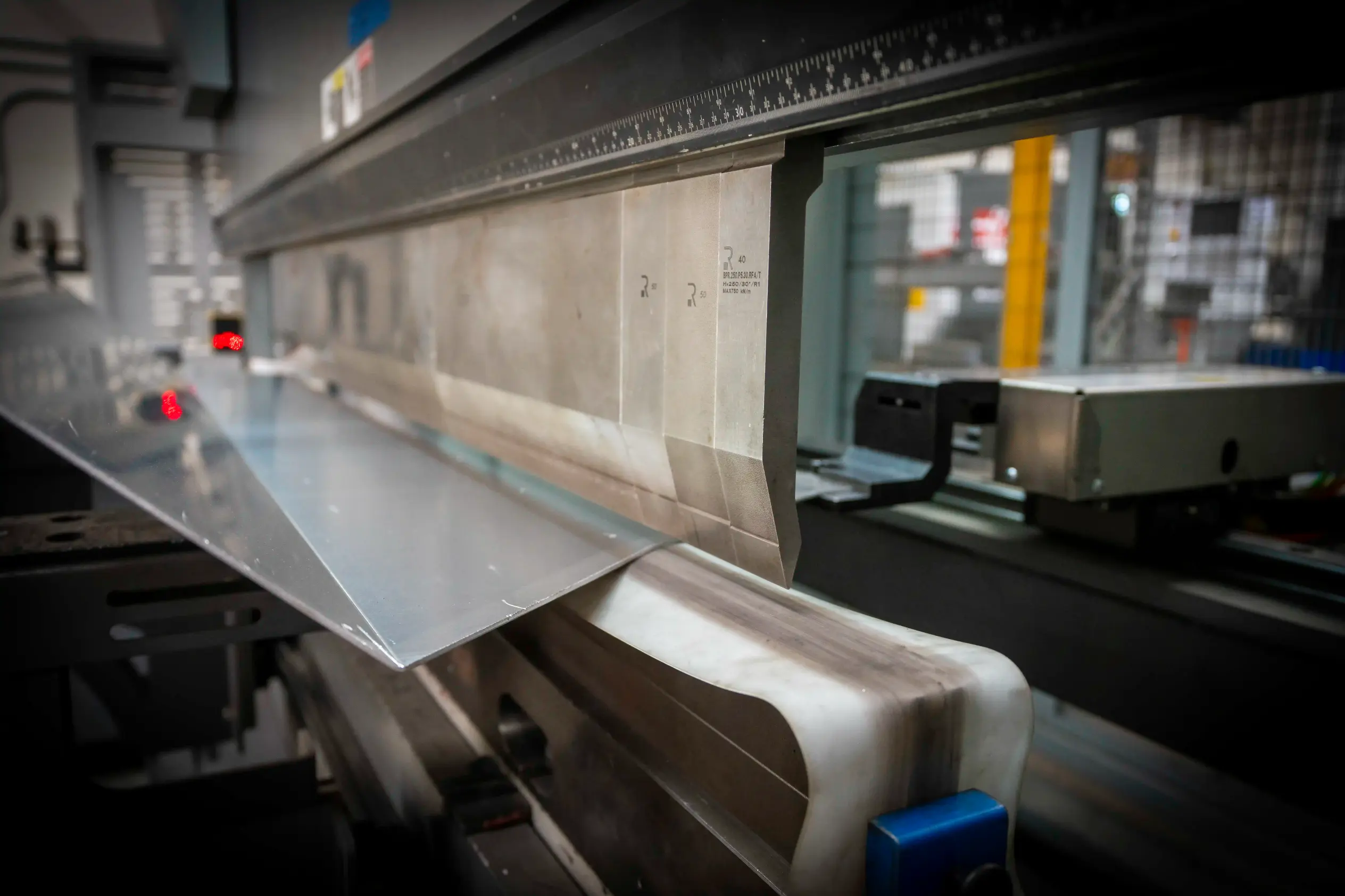
Press brake capacity
| Press brakes | Bystronic ByBend Smart 160 (160 ton), Amada RG-80 (80 ton) |
| Maximum tonnage | 188 tons |
| Maximum length | 10 ft |
| Steel | Up to 0.5 in thick |
| Aluminum | Up to 0.25 in thick |
| Stainless | Up to 0.25 in thick |
| Inner bend radius | 0.0775 in for 0.030–0.125 in material; 0.155 in for 0.134–0.250 in; 0.250 in for 0.3125–0.500 in |
| K-factor | 0.4 for steel, stainless and aluminum at every thickness above |
| Mild steel grade by thickness | A1008 CR to 0.125 in; A1011 P&O to 0.375 in; A36 HR above |
| CAD formats accepted | SolidWorks (.sldprt), Parasolid (.x_t), STEP, IGES |
| Lead time | Quoted with every job |
Tolerances
| Angle tolerance | ±0.5° |
| Flange length tolerance | ±0.015 in |
Tighter tolerances available on request.
Bending design rules
| Minimum flange length | 0.25 in for material 0.125 in and thinner; 0.5 in for material over 0.125 in |
| Minimum distance between bends | 0.5 in for material 0.125 in and thinner; 0.8 in for material over 0.125 in (return bends) |
| Holes and cutouts near a bend | Keep features at least the minimum flange length from the bend line (0.25 in or 0.5 in by thickness); closer than that they warp |
| Length by thickness | 0.125 in and thinner: 10 ft in any material. To 0.25 in: 10 ft in mild steel and 5052, about 5 ft in stainless (call for longer). Over 0.25 in: 60 in, mild steel only |
| Flanges on parts over 96 in | Maximum 16 in flange; the brake frame blocks anything longer |
| Box flanges | Maximum 5 in deep |
| Hems | Up to 32 in long |
| Stainless alloys | 304 and 316; not formed over 0.25 in |
| Aluminum alloys | 5052 at every thickness listed. 6061 only at 0.06 in and thinner, and better annealed first |
These are working limits, not hard stops. If a part sits near one of them, call (909) 351-0081 before you finish the design and we will tell you what the brakes will do.
Bending plate after laser cutting is where repeatability is won or lost. Our press brakes use modern controls that generate the bend program automatically and guide the operator through die placement and bend order, which takes a large source of human error out of the process.
Programs are saved, so a reorder six months later forms exactly the way the first article did. Tooling is kept new and maintained for the same reason — consistency over time is the whole point.
Submit a 3D CAD file rather than a flat pattern where you can. Model with the correct k-factor and bend radius and the flat pattern we derive will match the formed part; our published chart lists the values to use.
Forming runs on two CNC press brakes, a 160 ton Bystronic ByBend Smart 160 and an 80 ton Amada RG-80, in steel, stainless and aluminum. The plate comes off our own lasers, cut from the mild steel grade that suits the thickness: A1008 cold rolled up to 0.125 in, A1011 pickled and oiled over 0.125 to 0.375 in, and A36 hot rolled above that.
Cut-and-form jobs are quoted as one. Bending is a per-piece operation, so it scales with quantity, while setups are charged once per unique part per run, so the per-piece price falls as quantity rises. A DXF alone cannot be quoted because it carries no thickness; send the formed 3D part and we derive the flat pattern. Tight tolerances, finishes and hardware call-outs go on a PDF drawing with the upload.
From Fontana we form parts for fabricators and OEMs across San Bernardino and Riverside counties, Los Angeles and Orange County, and ship across Southern California. ITAR or export-controlled files should not go through the instant quote; email them to sales@calwestmfg.com.
Common questions
What are your press brake limits?
188 tons and 10 feet of bed. Steel up to 0.5 inch thick; aluminum and stainless up to 0.25 inch. Mild steel over 0.25 inch is limited to 60 inches long.
What is the minimum flange length and bend spacing?
Minimum flange is 0.25 inch on material 0.125 inch and thinner, 0.5 inch on anything thicker. Bends need 0.5 inch between them on thin material and 0.8 inch on thick. Holes and cutouts closer to a bend line than the minimum flange will warp.
What inside bend radius and k-factor should I model?
Model to the radii we tool for: 0.0775 inch inside radius for 0.030 to 0.125 inch material, 0.155 inch for 0.134 to 0.250 inch, and 0.250 inch for 0.3125 to 0.500 inch. Use the k-factor values from our published chart so the flat pattern matches the formed part.
Should I send a flat pattern or a 3D model?
Send the 3D model. We derive the flat pattern from it with the correct k-factor and bend radius, which is more reliable than a flat pattern generated with assumed values.
Will a reorder form the same as the first run?
Yes. Bend programs are generated from the model and saved, so a reorder months later forms exactly the way the first article did.
What press brakes do you run?
Two CNC press brakes: a 160 ton Bystronic ByBend Smart 160 and an 80 ton Amada RG-80, forming steel to 0.5 inch and stainless and aluminum to 0.25 inch, up to 10 feet long.
Where is the press brake shop?
Fontana, California, in the Inland Empire. We form parts for customers across San Bernardino and Riverside counties, Los Angeles and Orange County, and ship across Southern California.
Before you send a file
Other services
- Tube Laser Cutting
- CNC Tube Bending
- Plate Laser Cutting
- Welding
- CNC Machining
- Weldments
- Robotic Integration
- All services
Design guides and reference
- Tube bend radius chart (CLR)
- Tube bending design rules
- Machine capacity and max sizes
- Plate stock sizes and steel grades
- How our instant quote prices a job
- Tubing in SolidWorks video course
- All design guides
- Quality and AS9100D certification
- Case studies
- Contact us
Get a quote on press brake forming
Send a 3D model in Parasolid, STEP or IGES for the fastest quote.
Request a quote →