
TIG and MIG Welding Services in Southern California
TIG, MIG and robotic welding, custom weldments and full assembly in Fontana, California, by AWS-certified welders in the same facility that cuts and forms the parts, so the whole build stays under one roof.
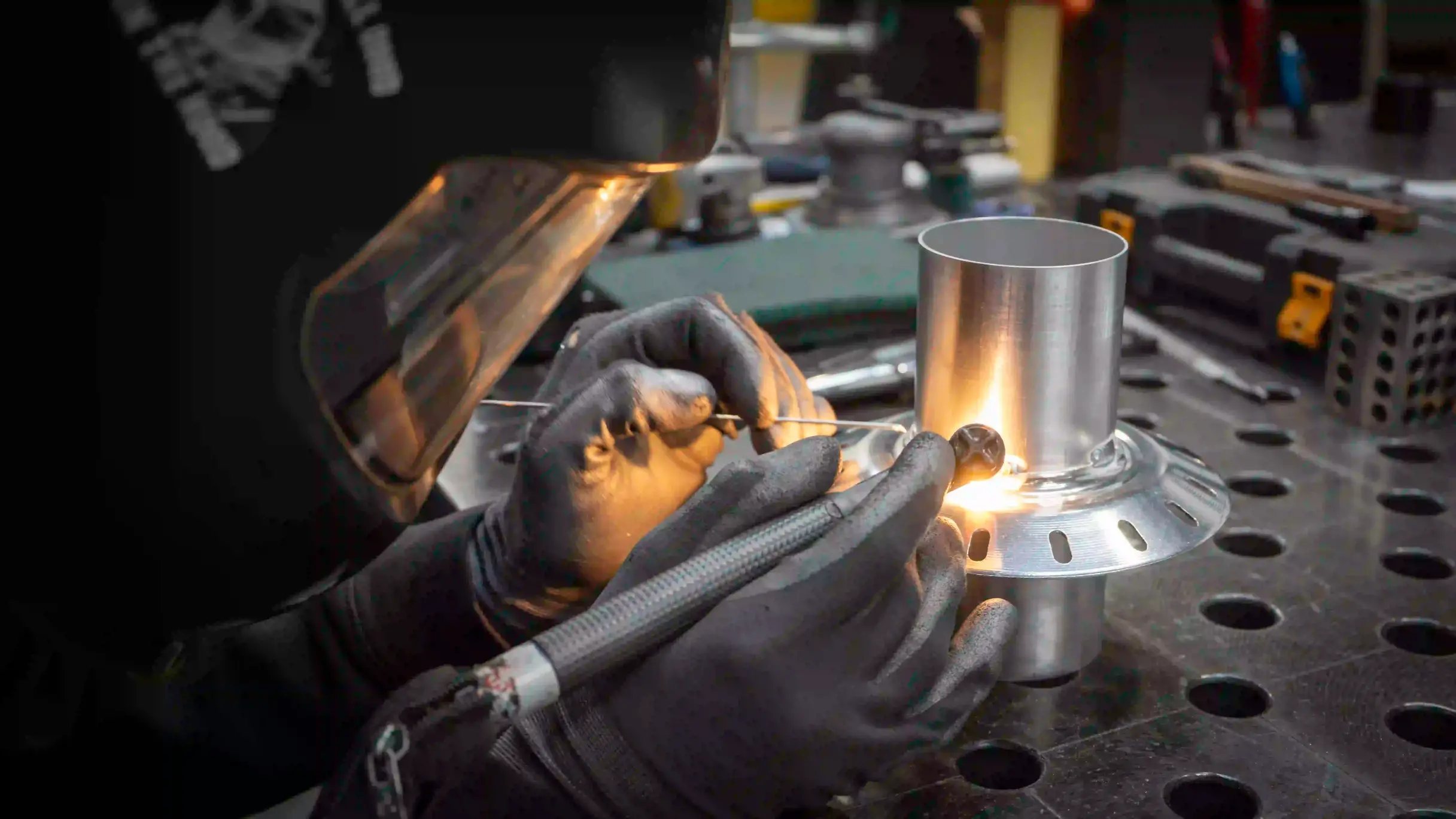
Welding department
| Processes | TIG, MIG, pulse MIG, push-pull aluminum MIG, flux-core; manual and robotic |
| Materials | Mild steel (A36, A1008, A1011), 4130 chromoly, 304 and 316 stainless, 5052, 5083 and 6061 aluminum |
| Thickness | Thin-gauge sheet through multi-pass plate over 1/2 in |
| Welder certifications | AWS D1.1, D1.2, D1.6 and D17.1 |
| Procedures | Written WPS and PQR on file; customer-supplied WPS accepted; CWI on call |
| Robotic cell | FANUC ArcMate 210iD/12L long-reach robot, Lincoln Power Wave source |
| MIG stations | Miller Millermatic 255 and 252 |
| TIG stations | Miller Dynasty 400, Miller Syncrowave 350 LX, Everlast |
| Fixturing | 4 ground 5 × 10 ft tables, rotary positioners, fixtures built in-house |
| Lifting | 12-ton remote gantry crane; single parts to 24,000 lb |
| Weld inspection | Dye penetrant and magnetic particle in-house; X-ray and ultrasonic sent out |
| Finishing | Beveling, post-weld straightening, grind-flush and cosmetic blend in-house; stress relief sent out |
| Dimensional inspection | Zeiss Spectrum CMM, Keyence WM-C6025 wide-area CMM, Keyence VL 3D scanner |
| Typical work | Bent-tube frames and chassis, machine bases, robot-cell frames, brackets and mounts, enclosures, tanks, guarding |
| Scope | Weldments, sub-assembly and full assembly |
| Maximum weldment size | Up to 50 × 12 × 8 ft shipped; 14 ft wide doors and a semi trailer are the limit |
| Upstream in-house | Tube laser, plate laser, press brake |
| Quality system | AS9100D and ISO 9001 certified |
| Lead time | Quoted with every job |
Welding sits in the same building as the tube laser, the plate laser and the press brakes. That matters more than it sounds: parts never ship between vendors mid-build, nothing waits on someone else's schedule, and when a fit-up problem appears there is one shop accountable for it rather than three pointing at each other.
Because the cut parts arrive with keys, tabs and etched part numbers already in them, assemblies locate themselves. Less fixturing, less measuring, fewer mistakes on long weldments.
The weld department runs TIG, MIG, pulse MIG, push-pull aluminum MIG and flux-core, manual and robotic. Manual stations are Miller Millermatic 255 and 252 MIG welders, and Miller Dynasty 400, Miller Syncrowave 350 LX and Everlast TIG welders, on four ground 5 × 10 ft fixture tables, with rotary positioners for round and repeat work; we build our own weld fixtures. Production and repeat weldments run in a robotic cell: a FANUC ArcMate 210iD/12L long-reach robot on a Lincoln Power Wave power source.
Materials we weld every week: mild steel (A36, A1008 and A1011), 4130 chromoly, 304 and 316 stainless, and 5052, 5083 and 6061 aluminum, from thin-gauge sheet through multi-pass welds on plate over 1/2 in.
Our welders are certified to AWS D1.1 (structural steel), D1.2 (structural aluminum), D1.6 (stainless steel) and D17.1 (aerospace fusion welding). Written weld procedures (WPS and PQR) are on file, we weld to customer-supplied procedures, and a Certified Welding Inspector is on call. Dye-penetrant and magnetic-particle inspection are done in-house, radiographic or ultrasonic testing is sent out when a job calls for it, and finished weldments are checked on the same Zeiss Spectrum CMM, Keyence WM-C6025 wide-area CMM and Keyence VL 3D scanner as our machined parts, under the same AS9100D quality system.
Beveling and weld prep, post-weld straightening, and grinding flush or cosmetic blending are done in-house; stress relief is sent out. A 12-ton remote-controlled gantry crane puts single parts up to 24,000 lb on the weld table. The largest weldment to leave the building measured 50 × 12 × 8 ft; the practical limit is what fits through our 14 ft wide doors and on a semi trailer. Typical work: bent-tube frames and chassis, machine bases and robot-cell frames, brackets and mounts, enclosures, tanks and guarding, including large, heavy-section aluminum assemblies.
Customers are across the Inland Empire, Los Angeles and Orange County, and parts ship across Southern California. If your weldment needs a material, process or certification you do not see here, ask; the answer is usually a phone call.
Common questions
Which welding processes do you run?
TIG, MIG, pulse MIG, push-pull aluminum MIG and flux-core, manual and robotic, for weldments, sub-assemblies and full assemblies from small brackets through large frames and structures. Production and repeat weldments run in a FANUC robotic welding cell on a Lincoln Power Wave source.
What materials do you weld?
Mild steel (A36, A1008 and A1011), 4130 chromoly, 304 and 316 stainless, and 5052, 5083 and 6061 aluminum, including large, heavy-section aluminum assemblies. If your assembly calls for another material, ask when you request the quote.
What thickness range do you weld?
From thin-gauge sheet and aluminum through multi-pass welds on plate over 1/2 in. Tell us the material and thickness with the model and we confirm the process and procedure before quoting.
Are your welders certified?
Yes. Our welders hold AWS D1.1 (structural steel), D1.2 (structural aluminum), D1.6 (stainless steel) and D17.1 (aerospace fusion welding) certifications. Written WPS and PQR are on file, we weld to customer-supplied procedures, and a Certified Welding Inspector is on call. We do not currently hold AWS D1.3 or ASME Section IX qualifications.
How are welds inspected?
Dye-penetrant and magnetic-particle inspection are done in-house; radiographic or ultrasonic testing is sent out when the drawing calls for it. Dimensions are checked on a Zeiss Spectrum CMM, a Keyence WM-C6025 wide-area CMM and a Keyence VL 3D scanner under our AS9100D quality system.
How large a weldment can you build?
The largest weldment to leave the building measured 50 by 12 by 8 ft, and a 12-ton remote-controlled gantry crane puts single parts up to 24,000 lb on the weld table. The practical limit is what fits through a 14 ft wide door and on a semi trailer.
Do you do weld prep and post-weld finishing?
Beveling and weld prep, post-weld straightening, and grinding welds flush or cosmetic blending are done in-house. Stress relief is sent out to a partner when the job calls for it.
Where do you serve?
We are in Fontana, California, in the Inland Empire, and weld for customers across San Bernardino and Riverside counties, Los Angeles and Orange County. Parts ship across Southern California.
Do you cut and form the parts you weld?
Yes. Welding sits in the same building as the tube laser, the plate laser and the press brakes, so parts never ship between vendors mid-build and one shop is accountable for fit-up. Cut parts arrive with keys, tabs and etched part numbers already in them, so assemblies locate themselves.
What quality certifications does the weld shop hold?
CalWest is AS9100D and ISO 9001:2015 certified and ITAR registered, and the welders carry the AWS certifications listed above.
Before you send a file
Other services
- Tube Laser Cutting
- CNC Tube Bending
- Plate Laser Cutting
- Press Brake Forming
- CNC Machining
- Weldments
- Robotic Integration
- All services
Design guides and reference
- Tube bend radius chart (CLR)
- Tube bending design rules
- K-factor and bend radius chart
- Machine capacity and max sizes
- Plate stock sizes and steel grades
- How our instant quote prices a job
- Tubing in SolidWorks video course
- Sheet metal in SolidWorks video course
- All design guides
- Contact us
Get a quote on welding
Send the assembly model and we will quote cut, form and weld as one job. Note the weld code or WPS the job must meet.
Request a quote →